
Is a Tax Break Possible Under the New Tax Structure in Nigeria? (2026 Guide)
December 20, 2025
How to Prepare a Financial Statement from a Bank Statement
January 24, 2026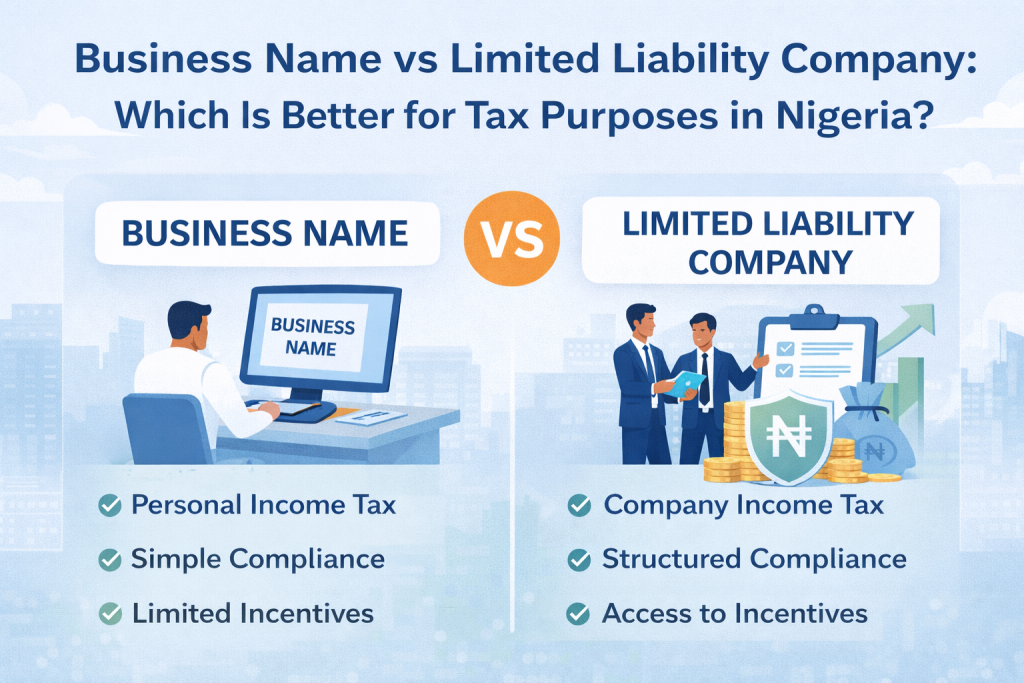
Are you looking for a comparison of Business Name vs Limited Liability Company? If yes, this guide is for you.
Choosing the right business structure is one of the most important decisions an entrepreneur will ever make.
Beyond branding and credibility, your choice directly affects how much tax you pay, how you file returns, and how the tax authorities treat your business.
Many Nigerian entrepreneurs ask:
Is it better to register as a Business Name or a Limited Liability Company (LLC) for tax purposes?
The answer depends on your income level, growth plans, compliance capacity, and long-term goals.
In this article, we break down the tax implications of Business Names and Limited Liability Companies in Nigeria, compare them side by side, and help you decide which option is more tax-efficient for your business.
Discover How to Register for a Tax Identification Number (TIN) in Nigeria — Step-by-Step Guide.
Understanding the Two Business Structures in Nigeria
Before diving into taxes, let’s briefly explain both structures.
What Is a Business Name?
A Business Name (also called an Enterprise) is the simplest form of business registration in Nigeria. It is typically used by:
- Sole proprietors
- Small businesses
- Freelancers and traders
The business is not legally Independent from the owner.
Learn How Much to File Annual Returns for a Business Name in Nigeria.
What Is a Limited Liability Company (LLC)?
A Limited Liability Company (LLC) is a separate legal entity from its shareholders. It is suitable for:
- Growing businesses
- Companies with partners or investors
- Businesses seeking credibility and scalability
Tax Framework in Nigeria: Business Name vs Limited Liability Company
The main distinction is how income is taxed.
Taxation of a Business Name in Nigeria
- Type of Tax Paid
Business Names are taxed under Personal Income Tax (PIT), not Company Income Tax.
- The owner pays tax on business profit as personal income
- Tax is administered by the State Internal Revenue Service (SIRS)
- Tax Rates
Personal Income Tax in Nigeria is progressive, typically ranging from:
- 7% to 24%, depending on income level
This means:
- Small businesses with modest profits often pay lower effective tax
- As income grows, tax liability increases significantly
- Filing Requirements
- Annual Personal Income Tax return
- Business income disclosure
- PAYE (if the business has employees)
- Advantages for Tax Purposes
✔ Lower tax burden for small profits
✔ Simpler compliance
✔ Fewer statutory filings
- Limitations
❌ No separation between personal and business income
❌ Limited access to tax incentives
❌ Higher tax burden as income increases
❌ Less credibility for large contracts
Taxation of a Limited Liability Company in Nigeria
- Type of Tax Paid
Limited Liability Companies are taxed under the Company Income Tax (CIT).
- The Federal Inland Revenue Service (FIRS) is responsible for tax administration.
- Company Income Tax Rates
Under Nigerian tax law:
- 0% CIT for small companies (turnover ≤ ₦25 million)
- 20% CIT for medium companies (₦25m – ₦100m)
- 30% CIT for large companies (above ₦100m)
This makes LLCs surprisingly tax-efficient for structured businesses.
You can check out How to Reduce Taxable Income in a New Regime: Smart Strategies for Businesses and Individuals.
- Other Applicable Taxes
- Value Added Tax (VAT)
- Withholding Tax (WHT)
- Education/Development levies (where applicable)
- PAYE for employees
- Filing Requirements
- Annual audited financial statements
- CIT returns
- VAT monthly returns
- WHT and PAYE filings
- Advantages for Tax Purposes
✔ Lower effective tax for growing businesses
✔ Access to tax incentives and capital allowances
✔ Clear separation of business and personal income
✔ Better tax planning opportunities
- Limitations
❌ Higher compliance cost
❌ More documentation
❌ Professional support is often required
Learn more about how to Process Tax Clearance for a New Company in Nigeria (2025 Guide).
Business Name vs Limited Liability Company: Tax Comparison Table
| Feature | Business Name | Limited Liability Company |
| Governing Tax |
Personal Income Tax |
Company Income Tax |
| Tax Authority |
State IRS |
FIRS |
| Tax Rate |
7% – 24% |
0% – 30% |
| Small Business Benefit |
High |
High (0% CIT possible) |
| Access to Incentives |
Limited |
Extensive |
| Compliance Complexity |
Low |
High |
| Best for | Micro & small businesses | Growing & structured businesses |
Which Is Better for Tax Purposes in Nigeria?
A Business Name Is Better If:
- You earn relatively low profits
- You want simple tax compliance
- You operate alone or as a small trader
- You are testing a business idea
A Limited Liability Company Is Better If:
- Your business is growing or scalable
- You want to separate personal and business taxes
- You plan to access tax incentives or investors
- You want lower long-term tax exposure
- You need credibility for contracts and partnerships
👉 Important Insight:
Many entrepreneurs wrongly assume LLCs always pay more tax.
In reality, small companies can pay 0% Company Income Tax, making LLCs more tax-efficient than Business Names in some cases.
Common Tax Mistakes Entrepreneurs Make
- Choosing a structure based only on registration cost
- Ignoring future tax implications
- Mixing personal and business income
- Failing to file returns on time
- Not using professional tax planning
These mistakes often lead to penalties, audits, and overpayment of taxes.
How Skypro Professional Services Can Help
At Skypro Professional Services, we help entrepreneurs:
- Choose the most tax-efficient business structure
- Register Business Names and Limited Liability Companies
- Handle all tax registrations and filings
- Provide SME tax planning and compliance support
- Avoid penalties and unnecessary tax costs
We don’t just register businesses — we help you build them correctly from a tax perspective.
Conclusion: Business Name vs Limited Liability Company
So, Business Name or Limited Liability Company — which is better for tax purposes in Nigeria?
There’s no one-size-fits-all answer.
- Business Names are ideal for small, low-income businesses that want simplicity.
- Limited Liability Companies offer better tax planning, incentives, and long-term efficiency for growing businesses.
The smartest choice is the one that aligns with your current income and future plans.
Need Help Choosing the Right Structure?
Let Skypro Professional Services guide you with expert tax and compliance advice.
📧 info@skyproservices.com.ng
📞 +234 9064646156
Skypro Professional Services — Tax. Compliance. Advisory.
FAQ 1: Is a Business Name cheaper to tax than a Limited Liability Company?
A Business Name may be cheaper for very small businesses, but Limited Liability Companies can be more tax-efficient as businesses grow, especially with 0% CIT for small companies.
FAQ 2: Does a Limited Liability Company always pay more tax?
No. Small companies with a turnover below ₦25 million can pay 0% Company Income Tax, making LLCs very tax-efficient.
FAQ 3: Which structure is better for long-term tax planning?
A Limited Liability Company offers better long-term tax planning, access to incentives, and separation of personal and business income.
FAQ 4: Can I convert my Business Name to a Limited Liability Company later?
Yes. Many businesses start as Business Names and later incorporate as Limited Liability Companies as they grow.