Step-by-Step Guide to Registering Your Business
April 4, 2026
How to Identify Cash Flow Problems in Your Business (10 Warning Signs)
November 17, 2026
Do you want to know how to Calculate Actual Business Profit?
Are you making sales every day, receiving customer payments, and watching money enter your business account, yet still struggling to understand where it all goes?
Here is a hard truth: Making sales does not necessarily mean your business is profitable.
Many business owners in Nigeria confuse revenue with profit. They see ₦5 million entering their business account and assume they have made ₦5 million. Unfortunately, this misunderstanding can lead to poor financial decisions, unnecessary spending, cash shortages, and even business failure.
What if you discovered that your business has been operating at a loss despite recording impressive sales?
Or that you have been withdrawing money from your business without knowing whether you are taking home actual profit or eating into your working capital?
In this article, you will learn how to calculate actual business profit, identify hidden expenses, understand the different types of profit, and determine how much your business truly earns.
Ready to take control of your business finances? Keep reading, and discover how to stop guessing and start making informed financial decisions.
Learn more about Expert Bookkeeping Services in Nigeria: Why Your Business Needs Professional Bookkeeping
What Is Actual Business Profit?
Actual business profit is the amount of money your business earns after deducting all relevant business costs and expenses from its revenue over a particular period.
In simple terms, it is what remains after accounting for the cost of producing or purchasing your products, running your operations, paying employees, settling bills, and meeting other business obligations.
For example, imagine you own a supermarket in Lagos.
Your business records total sales of ₦5,000,000 in one month. However, you spent money on inventory, salaries, electricity bills, rent, and other operating expenses.
Although your sales are ₦5 million, your actual profit could be significantly lower.
This is why business owners must look beyond sales figures and understand their financial performance.
Learn More about How Virtual CFOs are Revolutionizing Small Business Finances.
1. Understand the Difference Between Revenue, Profit and Cash Flow
Before calculating your actual business profit, you must understand three important financial terms.
Revenue: This is the total income generated from selling goods or providing services before deducting expenses.
Profit: This is what remains after deducting the relevant costs and expenses from revenue.
Cash Flow: This represents the movement of money into and out of your business during a particular period.
These three concepts are related but do not mean the same thing.
For example, your business may record ₦10 million in sales, but if customers have only paid ₦6 million, your bank account will not reflect the entire revenue.
Similarly, you may report a profit of ₦2 million but still experience cash shortages because customers owe you money, you have outstanding supplier obligations, or your cash is tied up in inventory.
Remember: Revenue tells you how much you sold, profit tells you how much you earned, and cash flow tells you how much money is available to meet your financial obligations.
2. Calculate Your Total Business Revenue
The first step in calculating actual business profit is determining your total revenue for the period under review.
Revenue may come from:
- Sales of products.
- Service charges.
- Consulting fees.
- Delivery or other business service income.
- Other income generated from normal business activities.
For example, assume a food business records the following sales in November:
| Revenue source | Amount |
|---|---|
| Food sales | ₦2,500,000 |
| Drinks sales | ₦700,000 |
| Catering services | ₦800,000 |
| Total revenue | ₦4,000,000 |
Your total revenue is ₦4 million.
However, this is not your profit. You must first deduct the costs associated with generating those sales.
For accurate reporting, use revenue earned during the period rather than simply adding all the money received into your bank account. Also account for sales returns, discounts, and applicable taxes collected on behalf of the government.
You can check out: Accounting and Bookkeeping Services for Small Businesses in Nigeria: Why They Are Crucial for Your Success
3. Calculate Your Cost of Goods Sold (COGS)
Cost of Goods Sold (COGS) represents the direct cost of the products sold or services delivered during a particular period.
For a supermarket, this includes the purchase cost of goods sold.
For a restaurant, it includes ingredients and other direct food costs.
For a manufacturing business, it includes direct materials, direct labour, and applicable production overheads.
The formula for calculating Cost of Goods Sold is:
COGS = Opening Inventory + Purchases + Direct Costs – Closing Inventory
Let’s use our food business example.
Assume the business has the following figures:
| Description | Amount |
|---|---|
| Opening inventory | ₦300,000 |
| Purchases during the month | ₦1,500,000 |
| Direct production costs | ₦200,000 |
| Closing inventory | (₦400,000) |
| Total COGS | ₦1,600,000 |
Therefore:
COGS = ₦300,000 + ₦1,500,000 + ₦200,000 – ₦400,000
COGS = ₦1,600,000.
This means the business spent ₦1.6 million on the goods and direct production costs attributable to the sales generated during the period.
Proper inventory management is essential here. If you do not accurately track your opening and closing inventory, your profit calculation may be misleading.
4. Calculate Your Gross Profit
Gross profit is the amount remaining after deducting the cost of goods sold from total revenue.
The formula is:
Gross Profit = Total Revenue – Cost of Goods Sold
Using our example:
Total Revenue = ₦4,000,000
Cost of Goods Sold = ₦1,600,000
Gross Profit = ₦4,000,000 – ₦1,600,000
Gross Profit = ₦2,400,000
This means the business generated ₦2.4 million after covering the direct costs of the products and services sold.
However, you are not done calculating your actual profit.
You still need to account for the expenses involved in running the business.
5. Identify and Deduct All Operating Expenses
Operating expenses are the costs incurred in running your business that are not included in the cost of goods sold.
These expenses may include:
- Staff salaries and wages.
- Office or shop rent.
- Electricity and generator fuel.
- Internet and telephone bills.
- Transportation and logistics.
- Marketing and advertising.
- Repairs and maintenance.
- Professional fees.
- Insurance.
- Administrative expenses.
- Software subscriptions.
- Depreciation of business assets.
Let’s continue with our food business example.
Assume the monthly operating expenses are:
| Expense | Amount |
|---|---|
| Staff salaries | ₦500,000 |
| Rent allocation | ₦150,000 |
| Electricity and fuel | ₦200,000 |
| Transportation | ₦100,000 |
| Marketing | ₦80,000 |
| Internet and communication | ₦30,000 |
| Repairs and maintenance | ₦40,000 |
| Administrative expenses | ₦50,000 |
| Depreciation | ₦50,000 |
| Total operating expenses | ₦1,200,000 |
Gross Profit = ₦2,400,000
Operating Expenses = ₦1,200,000
Operating Profit = ₦2,400,000 – ₦1,200,000
Operating Profit = ₦1,200,000
At this point, the business has generated ₦1.2 million from its core operations before finance costs and income tax.
6. Deduct Finance Costs and Other Expenses
Many business owners forget to account for the cost of borrowing money.
If your business has a bank loan, overdraft, or other interest-bearing facility, the interest expense must be considered when calculating profit.
Other relevant non-operating expenses and income should also be considered.
For example:
| Description | Amount |
|---|---|
| Operating profit | ₦1,200,000 |
| Loan interest | (₦100,000) |
| Profit before tax | ₦1,100,000 |
Your business has generated ₦1.1 million profit before tax.
The principal repayment of a loan is not an expense in the income statement. It is a reduction of the outstanding loan liability and must be accounted for separately when analysing cash flow.
7. Deduct Applicable Income Tax to Determine Net Profit
Net profit is the profit remaining after deducting applicable income tax from profit before tax.
For our example, assume the estimated applicable income tax for the period is ₦100,000.
| Description | Amount |
|---|---|
| Profit before tax | ₦1,100,000 |
| Income tax expense | (₦100,000) |
| Net profit | ₦1,000,000 |
Therefore, the actual net profit for the month is ₦1 million.
Click to Download Your FREE Business Profit Calculator.
Note that the tax figure here is illustrative. Actual Nigerian business tax obligations depend on the business structure, applicable tax laws, taxable profit adjustments, and available reliefs. Tax should be calculated using the applicable rules rather than simply applying an arbitrary percentage to accounting profit.
8. Calculate Your Net Profit Margin
Knowing your net profit is important, but you should also understand how much profit your business generates from every naira of sales.
This is where net profit margin becomes useful.
The formula is:
Net Profit Margin = (Net Profit ÷ Total Revenue) × 100
Using our example:
Net Profit = ₦1,000,000
Total Revenue = ₦4,000,000
Net Profit Margin = (₦1,000,000 ÷ ₦4,000,000) × 100
Net Profit Margin = 25%
This means that for every ₦100 generated in revenue, the business retains ₦25 as net profit after the expenses and tax included in our calculation.
Tracking your net profit margin monthly helps you understand whether your business is becoming more profitable or whether increasing expenses are reducing your earnings.
9. Complete Example: How to Calculate Actual Business Profit
Let’s bring everything together.
Below is the complete profit calculation for our hypothetical food business.
| Description | Amount |
|---|---|
| Total revenue | ₦4,000,000 |
| Less: Cost of goods sold | (₦1,600,000) |
| Gross profit | ₦2,400,000 |
| Less: Operating expenses | (₦1,200,000) |
| Operating profit | ₦1,200,000 |
| Less: Finance costs | (₦100,000) |
| Profit before tax | ₦1,100,000 |
| Less: Income tax | (₦100,000) |
| NET PROFIT | ₦1,000,000 |
**The big lesson:** Although this business generated ₦4 million in revenue, its net profit was only ₦1 million.
That is a 25% net profit margin, not 100%!
Without proper financial records, the owner might mistakenly believe that the entire ₦4 million belongs to the business owner.
Checkout: How to Reduce Taxable Income in a New Regime: Smart Strategies for Businesses and Individuals
10. Five Common Mistakes That Make Business Owners Overestimate Their Profit
Even businesses that record daily sales can struggle to determine their actual financial performance.
Here are five common mistakes to avoid.
1. Treating all sales revenue as profit
Money received from customers is not automatically profit. You must first account for the cost of goods sold and operating expenses.
2. Ignoring small expenses
Expenses such as transportation, POS charges, bank charges, data subscriptions, repairs, and fuel may appear insignificant individually. However, they can accumulate into substantial amounts over time.
3. Failing to account for inventory losses
Damaged goods, expired products, theft, wastage, and stock shortages can reduce your actual profit. Regular stock counts help identify these problems.
4. Mixing personal and business finances
When business owners use business money to pay personal bills without proper documentation, it becomes difficult to determine how much the business actually earns.
5. Ignoring outstanding customer debts
Sales made on credit may increase reported revenue, but they do not automatically translate into cash in your bank account. Poor debt collection can create serious cash flow problems even when the business appears profitable.
11. How to Know Whether Your Business Is Truly Profitable
Calculating your profit once is not enough. You need a system for monitoring your financial performance consistently.
Here are practical steps to implement:
- Maintain accurate daily sales records.
- Record every business expense, regardless of how small it appears.
- Monitor inventory purchases, usage, and closing stock.
- Separate personal and business transactions.
- Reconcile your bank accounts regularly.
- Follow up on outstanding customer debts.
- Prepare monthly income statements.
- Compare actual expenses against your budget.
- Review your gross and net profit margins.
- Monitor your cash flow to ensure you can meet business obligations.
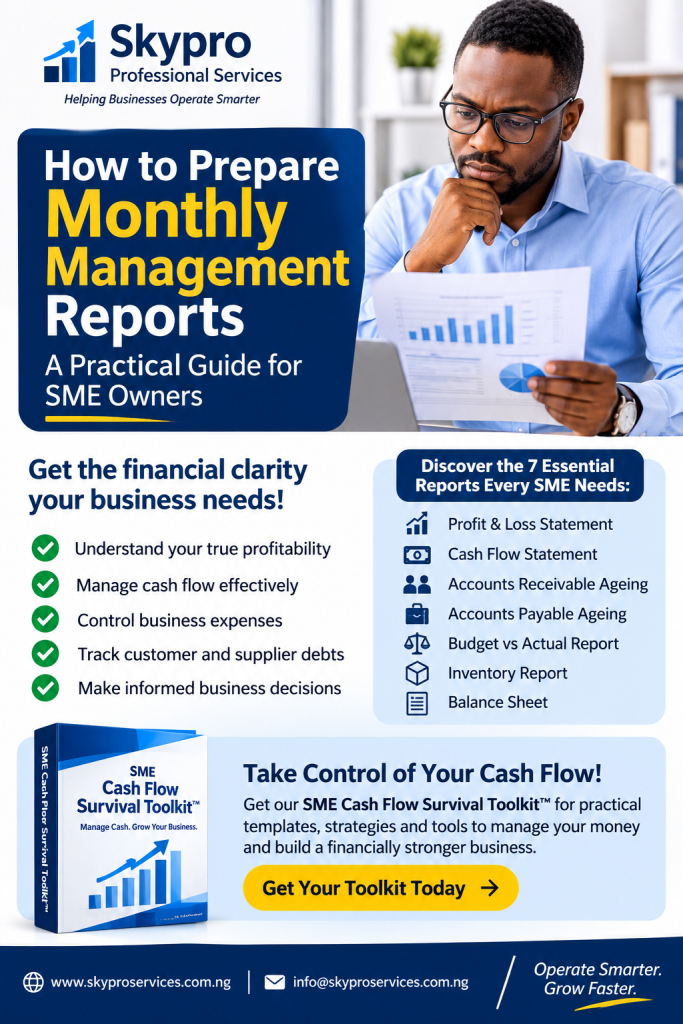
Ideally, every business owner should have access to a simple monthly financial report showing revenue, cost of sales, operating expenses, net profit, outstanding receivables, payables, and cash position.
You do not need to own a large company before introducing proper financial management systems.
Even a small business can benefit from accurate bookkeeping and regular financial reviews.
12. How the SME Cashflow Survival Toolkit™ Can Help You Take Control
Now that you understand how to calculate actual business profit, the next question is:
How do you ensure that your business retains enough money to survive, grow, and meet its financial obligations?
This is where many Nigerian SMEs struggle.
Some businesses generate millions in monthly revenue but constantly borrow money to pay salaries, settle suppliers, and fund daily operations.
Others make reasonable profits but experience cash shortages because customers delay payments, expenses are poorly controlled, or business owners withdraw money without a proper financial plan.
Understanding your profit is only the beginning. You must also know how to manage your cash, control expenses, recover outstanding debts, and make better financial decisions.
That is exactly why we created the SME Cashflow Survival Toolkit™.
It is a practical financial management resource designed to help Nigerian small business owners understand their numbers, improve cash flow, and build financially sustainable businesses.
What will you get inside the toolkit?
- Practical financial templates for monitoring business income and expenses.
- Excel cash flow management templates and dashboard.
- Business financial review checklists.
- A practical 30-day cash flow improvement plan.
- Emergency Cash Flow Action Plan.
- Debtor Follow-Up Scripts to help you recover outstanding payments.
- Expense Reduction Checklist.
- Weekly Financial Review Template.
Whether you run a supermarket, restaurant, fashion business, retail shop, consultancy, distribution company or other SME, these resources will help you develop better financial management habits.
Stop guessing your business profit. Stop wondering where your money goes. Start managing your business finances with confidence.
Get Your SME Cashflow Survival Toolkit™ Today!
Take the first step towards better financial control, improved cash flow, and a more sustainable business.
Click the link below to get immediate access:
Don’t wait until your business runs out of cash before taking your finances seriously.
Frequently Asked Questions (FAQs)
1. How do I calculate my business profit?
Subtract your cost of goods sold and operating expenses from total revenue. Then account for finance costs, other relevant items, and applicable income tax to determine your net profit.
2. What is the formula for calculating actual business profit?
A simplified formula is:
Net Profit = Revenue – Cost of Goods Sold – Operating Expenses – Finance Costs – Income Tax + Other Relevant Income – Other Relevant Expenses.
3. Is business turnover the same as profit?
No. Turnover represents revenue generated from business activities, while profit is what remains after deducting relevant costs and expenses.
4. How often should I calculate my business profit?
Ideally, prepare a profit and loss statement every month. This allows you to monitor performance, identify unnecessary expenses, and make timely business decisions.
5. Can my business be profitable but still experience cash shortages?
Yes. Your business can report accounting profits while experiencing cash shortages because customers have not paid their debts, inventory is tying up cash, loan repayments are due, or other working capital requirements are high.
6. What is a good profit margin for a small business?
There is no universal profit margin that is suitable for every business. Profitability depends on the industry, operating model, pricing strategy, cost structure, and business objectives. Compare your margins with your historical performance and relevant industry benchmarks.
7. Do I need an accountant to calculate my business profit?
You can learn basic profit calculations yourself, but professional accounting support can help ensure that your records, inventory, expenses, financial statements, and tax obligations are properly managed.
Final Thoughts
A successful business is not necessarily the business that makes the highest sales. It is the business that understands its numbers, controls its expenses, protects its cash flow, and consistently generates sustainable profits.
As a business owner, you should never have to guess whether your business is making money.
Know your revenue. Understand your expenses. Calculate your profit. Monitor your cash flow.
Your business deserves more than just sales. It deserves financial stability and sustainable growth.
Need professional support with your business accounting, bookkeeping, cash flow management, or financial controls?
Skypro Professional Services helps Nigerian SMEs build better financial systems through accounting, bookkeeping, financial advisory, internal controls, and tax compliance services.
Visit: https://skyproservices.com.ng
Email: info@skyproservices.com.ng
WhatsApp: +234 906 464 6156
Skypro Professional Services – Helping Businesses Achieve Financial Clarity, Efficiency and Compliance.
Are You Really Making Money in Your Business?
Download your FREE Business Profit Calculator and discover how much your business actually earns after expenses.
Stop guessing. Start calculating. Take control of your business finances.
FREE Excel Calculator – Designed for Nigerian SMEs.
#BusinessProfitability #SMEs #SmallBusinessNigeria #FinancialManagement #BusinessGrowth #Accounting #SkyproProfessionalServices #howtocalculateactualbusinessprofit